The UAE Leaves OPEC, Opening a New Landscape for Spanish Businesses
The United Arab Emirates’ formal departure from OPEC after six decades is not, despite the headlines, merely an energy story. For those of us who work within the Spain–Gulf business corridor, this move confirms a thesis that RLD has defended for years: the UAE is no longer a petroleum-based economy—it has become a global platform for services, investment, and technology.
Oil as Capital, Not the Destination
The reality is that the OPEC framework had become too restrictive for Dubai and Abu Dhabi. While the cartel seeks to support prices by limiting production, the UAE has invested heavily to increase its production capacity to 5 million barrels per day by 2027.
The strategy is straightforward. The UAE intends to monetize its oil reserves while extraction costs remain among the most competitive in the region, using those revenues to finance its economic transformation. This is not a rejection of its regional partners—it is an exercise in economic pragmatism.
The country has recognized that peak global oil demand is approaching and has chosen to generate liquidity today in order to invest in the post-oil economy, rather than preserve market share in a declining industry.
What This Means for Spanish Companies Operating in the Gulf
If you lead a corporate group or family-owned business with operations in the Gulf—or are considering entering the region—the UAE’s departure from OPEC has implications that extend far beyond energy prices.
Acceleration of Non-Oil Investment
A significant increase in sovereign investment is expected across sectors such as agribusiness, healthcare, renewable energy, and infrastructure.
The UAE’s major sovereign investment vehicles now have greater flexibility to diversify their portfolios more aggressively. For Spanish companies with competitive technologies, expertise, or strategic assets, the pool of potential partners has just expanded considerably.
Legal Certainty and a Pragmatic Business Environment
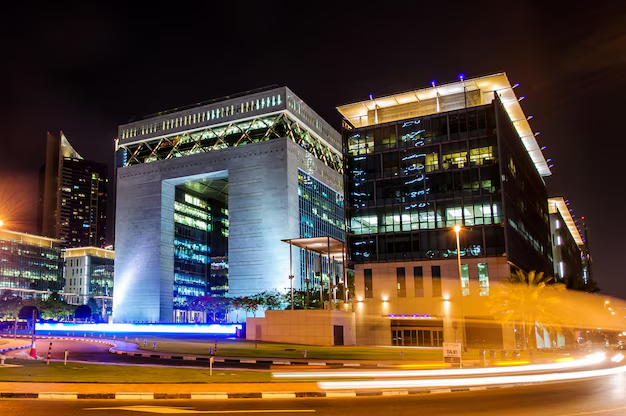
This decision is consistent with the UAE’s broader economic reforms, including foreign ownership liberalization and the regulatory frameworks of the Dubai International Financial Centre (DIFC) and the Abu Dhabi Global Market (ADGM).
The message to international investors is clear: the UAE is positioning itself as an independent, predictable, and globally competitive jurisdiction.
Managing Geopolitical Risk
There is no denying that leaving OPEC carries regional political implications. Today, operating successfully in the Gulf requires more than legal expertise—it requires advisors who understand the timing, relationships, and geopolitical dynamics that shape the region.
Our Perspective from the Ground
When we opened our office in the UAE in 2012, many Spanish firms viewed the region as an exotic and uncertain destination. Thirteen years—and more than one hundred M&A transactions—later, the market has validated what we anticipated from the beginning.
What we are witnessing today is the consolidation of a model we identified more than a decade ago.
At RLD, we are more than legal advisors—we are strategic partners supporting our clients’ international expansion. The UAE’s departure from OPEC does not change our long-term vision, but it reinforces our belief that now is the right time to structure investments, corporate vehicles, and wealth planning strategies in the Emirates with a long-term perspective.
If you are considering a corporate transaction or expanding into the UAE market, our teams in Madrid and Dubai are available to help you assess how this new landscape may affect your business and identify the best path forward.